
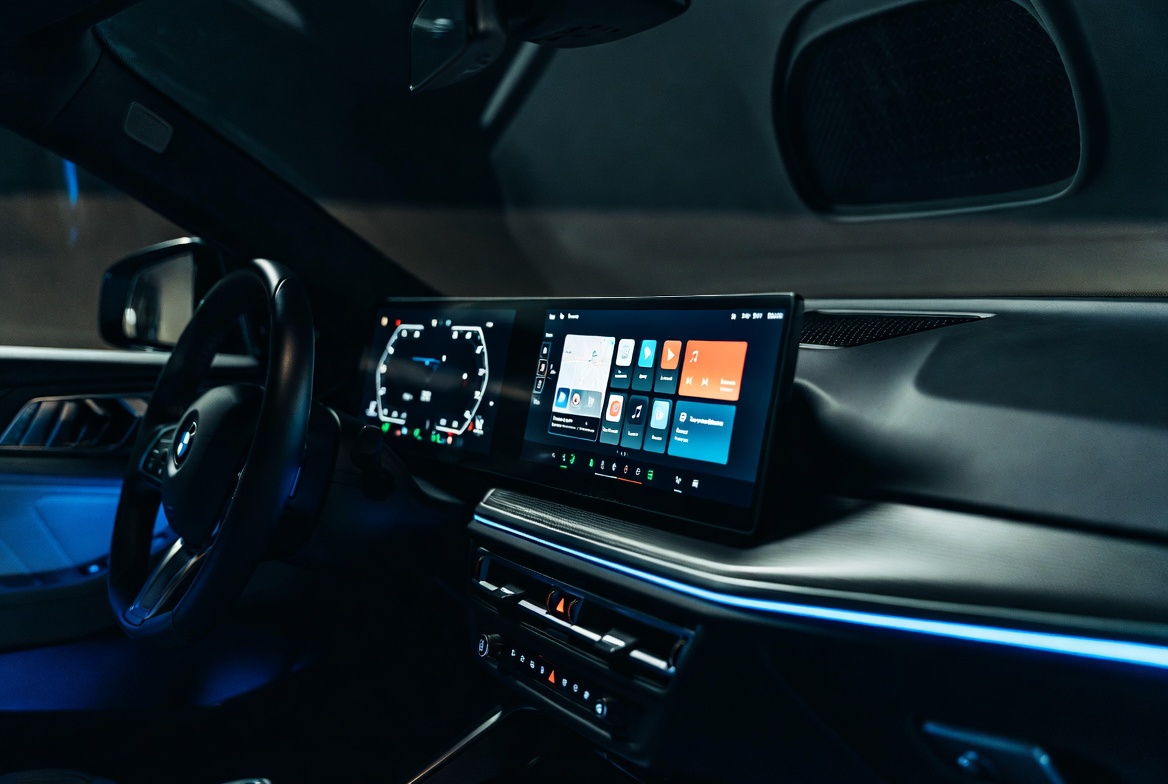
Your BMW's Infotainment Is Probably 5 Years Behind Your Phone
Most BMW owners don't realize how far behind their in-car system actually is — or how easily the gap can be closed.
Picture this: you're holding a 2024 flagship smartphone in your hand, yet every time you get behind the wheel, you're staring at a touchscreen whose logic hasn't moved since 2018. Sluggish taps, outdated maps, zero app support. This isn't an edge case — it's the daily reality for the majority of BMW drivers.
If you've ever sat at a red light, anxiously reaching for your phone because the built-in navigation was still "calculating route" — you've already felt the gap. If you've resorted to propping your phone on a cup-holder mount just to get a usable map, you know exactly what we're talking about.
But here's what's worth paying attention to: most owners have simply accepted this as normal. They assume "that's just how car screens work." The truth is, your infotainment system could be dramatically smarter than it is right now.
How Do You Measure an Infotainment System's Intelligence?
To help owners understand where their system actually stands, our engineering team developed a diagnostic framework we call the Infotainment Intelligence Level. It evaluates your car's digital experience across five core dimensions:
Across the board, most stock BMW systems land at roughly Level 2 — functional, but nowhere near good. Meanwhile, the current benchmark for a modern smart cockpit sits at Level 4 to Level 5.
Curious where your model ranks? Check the assessment tool
Why Your BMW Gets "Dumber" Over Time
This isn't your fault — it's a structural limitation.
BMW's factory infotainment runs on a customized Linux or QNX platform. These systems are rock-solid for stability, but the trade-off is an extremely slow update cadence — typically one major revision every two to three years. In that same window, your smartphone OS will have gone through half a dozen updates.
What's more, several BMW models don't natively support Android Auto. Our in-house infotainment engineers point out that this is a commercial strategy choice, not a technical limitation. A closed system means you can't install third-party apps — your car's capabilities are effectively locked at the moment it leaves the factory.
In other words, your BMW may still drive beautifully, but its "digital brain" is aging at a pace you can feel every time you tap the screen.
This Is More Than a "Nice-to-Have" Problem
Many owners dismiss an underwhelming infotainment system as a minor inconvenience. But when you map those inconveniences to their real-world consequences, the picture shifts significantly:
| Surface Symptom | Real-World Impact | |
|---|---|---|
| Laggy navigation, slow route loading | → | Divided attention while driving — a genuine safety risk |
| Missing features, phone dependency | → | Phone mounts, tangled cables, higher daily friction |
| No system upgrades available | → | System falls further behind each year — accelerating depreciation |
| No support for common apps | → | Essential tools inaccessible — lost time and productivity |
When you reframe the issue from "a slightly better experience" to safety, asset value, and daily efficiency, upgrading your infotainment stops being optional — it becomes something that costs you more the longer you put it off.
A Fix That Doesn't Require a New Car — or Tearing Apart the Old One
The good news: there's a mature, elegant solution. A plug-and-play multimedia Android smart box lets you keep your entire stock system intact while upgrading your Infotainment Intelligence Level from Level 2 straight to Level 5.
It doesn't replace your car's interface — it layers a full smart system on top of it. Once installed, your BMW's existing screen gains complete Android ecosystem access: Google Maps, Spotify, YouTube, Netflix, WhatsApp — every app you rely on your phone for, now running natively on the big screen.
It also unlocks wireless CarPlay and wireless Android Auto — no more fumbling for a cable every time you get in the car.
See the upgrade options for your model →
What Daily Life Looks Like After the Upgrade
These aren't hypotheticals — they're what real users do every day:
Google Maps has already plotted the fastest route around rush hour before you pull out of the driveway. Spotify's Daily Mix plays quietly in the background. All you have to do is drive.
Waze community alerts flag an accident two miles ahead. YouTube Music curates a non-stop playlist tailored to your taste. A long drive becomes something you actually look forward to.
Arrived 20 minutes early? Open Netflix on the full-size display and pick up where you left off last night. The screen is three times larger than your phone, and the car's speakers handle the rest.
Your iPhone stays in your pocket. Wireless CarPlay connects automatically the moment you sit down. No cables, no pairing rituals — just go.
The kids in the back watch cartoons on the car's screen. You focus on the road up front. No handing over your phone, no worrying about drops. Everyone's happy.
Find the right upgrade for your model
Does Your Infotainment Need an Upgrade?
Not sure if this applies to you? Run through a quick self-check:
…then your Infotainment Intelligence Level has likely fallen well behind the mainstream.
The good news: you don't need a new car, and you don't need to tear into your existing system. A single plug-and-play upgrade can bring your infotainment back in line with the current standard.
Why You Can Trust This
"The global automotive industry is in the middle of an Android-ization wave. Open ecosystems have become an irreversible trend. Our compatibility engineering team has completed in-depth testing across more than 200 BMW models to ensure every owner gets a stable, seamless upgrade experience."
Whether you drive a 3 Series, 5 Series, X3, or X5 — and whether it's a 2018 or a 2024 model — there's an adaptation kit built for your specific car.